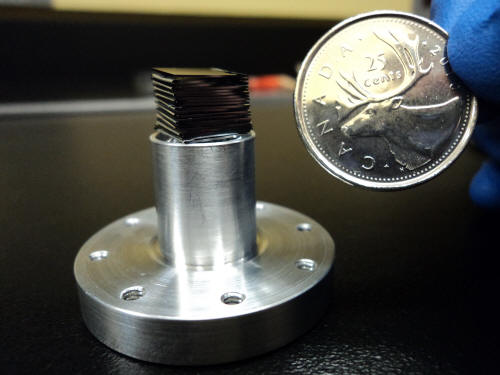
Humidity Chambers for Neutron and X-ray Scattering
When working with biological or
biophysical samples, the important thermodynamic parameters are
temperature but also hydration. Lipid membranes for instance as
model systems for more complex biological membranes cannot be
understood without taking into account the structure and dynamics of
their aqueous environment. The structure and dynamical properties of
the bound water layers next to the bilayer as well as the 'free'
(bulk) water further away from the water/lipid interface are of
importance in understanding the thermal, elastic and transport
properties of membranes. Furthermore, the interaction between two
bilayers is mediated by the hydration water. A recent Molecular
Dynamics (MD) simulation pointed out the importance of hydration
water dynamics for the understanding of the dynamical transition of
proteins. The sample is usually hydrated from (heavy/light) water
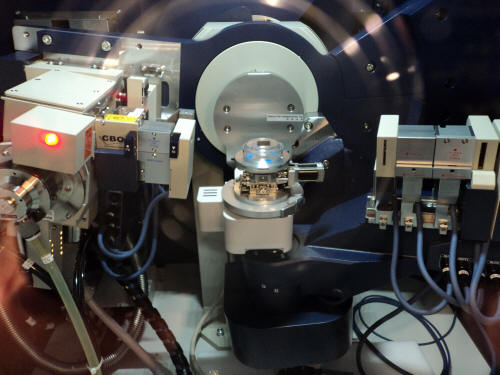
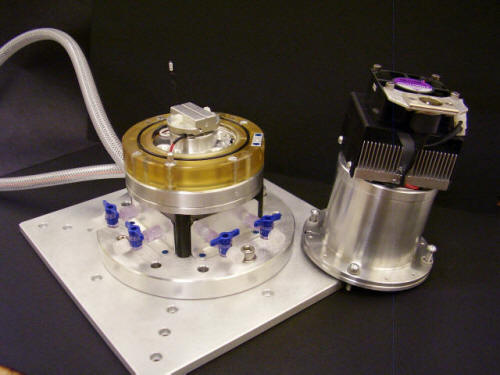
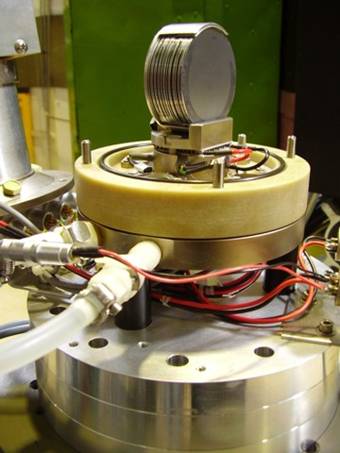
vapor to a beam path through bulk water. The basic design of
humidity cells is rather simple and consists of a water container
and the sample in a temperature controlled enclosed space. In
reality things are much more complex and the development of humidity
cells is a highly complex task and needs careful control of
temperatures to, e.g., avoid temperature gradients and temperatures
below the dew point what would lead to an immediate loss of
hydration.
Highlights
of the new design are:
1) The temperatures of the
sample, the water containers and the surrounding cell can be
adjusted independently from each other.
2) Tempering is fast by
Peltier elements.
3) The chamber is very
versatile, i.e., different covers can be fabricated and used for
different sample geometries and adapted to different neutron
instruments as three-axis, reflectometers, time-of-flight
instruments. For x-ray instruments, a Beryllium/Kapton window has
been built in.
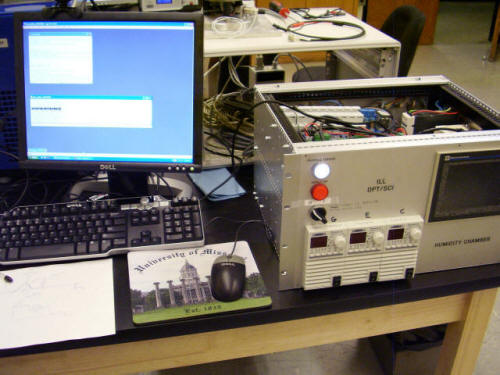
4) The chamber is
‘intelligent’, i.e., the electronics controls all temperatures and
the hydration. The communication to the instrument computer by RS232
or IEC bus or wireless LAN just includes set and is values for
sample temperature and hydration.
5) By regulating the
different temperatures it is possible to adjust different levels of
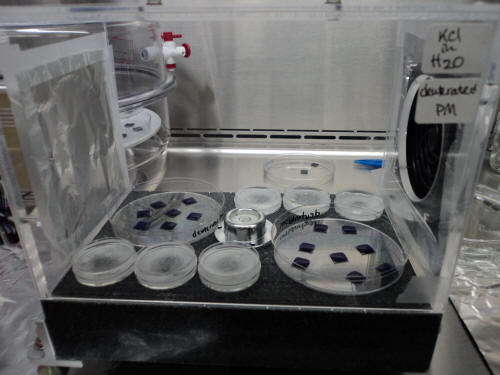
hydration. Usually the hydration is set by different saturated salt
solutions, i.e., K2SO4 for about 97 %RH, with the disadvantage that
the chamber has to be opened, the salt solution replaced and the
sample hydrated again, what usually took a few hours.
6) D2O and H2O
can be exchanged easily to measure at different scattering contrasts
without opening the cell.
 |